 ,
where
,
where
 is
the probability of exceeding the 0.91 m deflection and
is
the probability of exceeding the 0.91 m deflection and
 =0.01.
The resulting amplitude of the tower top is (according to ENV [2])
=0.01.
The resulting amplitude of the tower top is (according to ENV [2])Euro-SiBRAM’2002 Prague, June 24to 26, 2002, Czech Republic
Session 5
The SBRA method as the powerful technique for probabilistic design in aerodynamics and aeroelasticity of civil engineering structures
Prof. Miroš Pirner
Institute of Theoretical and Applied Mechanics
Academy of Sciences of the Czech Republic, Prosecká 76, 19000 Praha 9
pirner@itam.cas.cz
1. Introduction
For a probabilistic reliability assessment and design of civil engineering structures it is important to have a knowledge about the variation of all relevant variables. In the area of aerodynamics and aeroelasticity the method SBRA [8] is very profitable; it fulfils all requirements of designer for determination of the response to the loadings and calculation of the probability of failure.
In [1] the static and dynamic
response of TV tower shown in Fig. 1 from the view of the ability to
receive the defectiveless television signal is published. The
requirement of top displacement 0.91m at 99% of the operating time
can be expressed as ,
where
is
the probability of exceeding the 0.91 m deflection and
=0.01.
The resulting amplitude of the tower top is (according to ENV [2])
 (1)
(1)
Supposing that the tower
deflection curve corresponds to its fundamental natural mode (with
 )
we receive the safety function SF
)
we receive the safety function SF
 .
(2)
.
(2)
The probability corresponding
to
 is
calculated using the M-Star program. The out put from the
M-Star program is shown in Fig. 2. The probability of exceeding
is
calculated using the M-Star program. The out put from the
M-Star program is shown in Fig. 2. The probability of exceeding
 and
so the tower meets the serviceability requirement.
and
so the tower meets the serviceability requirement.
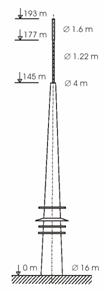
Fig. 1 TV tower exposed to wind load
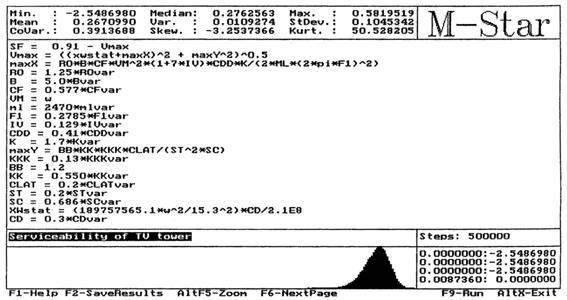
Fig. 2 Magnitude of the resulting amplitude; output from the M-Star program
2. And now few examples in
which the SBRA method is the powerful technique
The effects of
the static wind action manifest themselves most intensely in the wind
direction. The total along-wind force acting on a structure is
usually defined by the equation
 (3)
(3)
where
 (from
view of designer) are given deterministic. The wind speed
(from
view of designer) are given deterministic. The wind speed
 is
the probabilistic value and
is
the probabilistic value and
 aerodynamic
drag coefficient strong depends on the wind speed (Fig. 3a) and on
turbulence intensity (Fig. 3b).
aerodynamic
drag coefficient strong depends on the wind speed (Fig. 3a) and on
turbulence intensity (Fig. 3b).
Using M-Star program; wind
duration curve [8] and relations from Fig. 3 we receive the
probabilistic value of drag force
 .
.
Vincenc Strouhal as early as 1878 [7] described the vortex trail with a frequency
 (4)
(4)
where
 is
Strouhal number and
is
Strouhal number and
 is
diameter of cylinder
is
diameter of cylinder
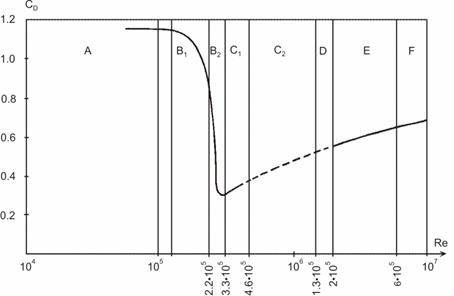
Fig. 3a Effect of
 number
on drag coefficient [3]
number
on drag coefficient [3]
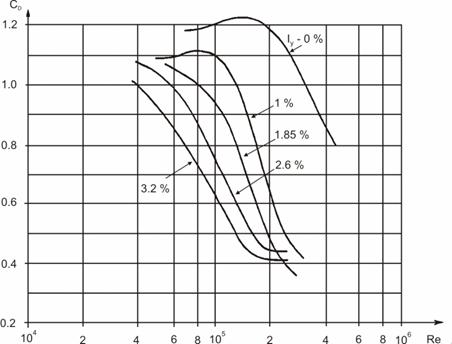
Fig. 3b Effect of Renumber and turbulence intensity
 on drag coefficient
[4]
on drag coefficient
[4]
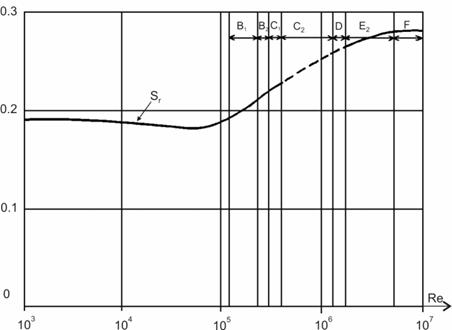
Fig. 4a Effect of Re number on Strouhal number
[5]
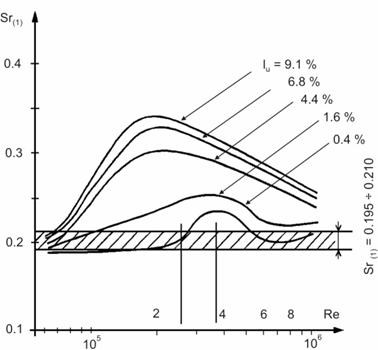
Fig. 4b Effect of Re number on Strouhal number
at
different turbulence intensities
 [6]
[6]
But the
Strouhal number
depends
on wind speed and
the turbulence intensity (Fig. 4). Using
M-Star program we receive the probabilistic value of shedding
frequency.
Parallel transmission line cables whose cross-section lie in the horizontal plane become unstable under certain conditions of wind and spacing. This loss of stability is caused by forces acting on a cable in the wake of another. The onset wind velocity of wake galloping is given by formula [7]
 (5)
(5)
where
 is the mass of the unit length
 logarithmic damping coefficient
 first natural frequency
 air density
diameter
 aerodynamic
coefficients of lift and drag
aerodynamic
coefficients of lift and drag
 angle (Fig.5)
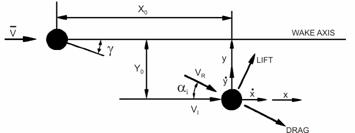
Fig. 5 Cross-section of parallel transmission lines
From view of designer the
values
 are
given deterministic, bat
are
given deterministic, bat
 strong
depend on the wind speed
strong
depend on the wind speed
 and
turbulence intensity. Using M-Star program we receive the
probabilistic value of onset velocity
and
turbulence intensity. Using M-Star program we receive the
probabilistic value of onset velocity

2. Summary and conclusions
Aerodynamics and aeroelasticity of civil engineering structures include the wind effects as a random process and therefore the structural response enables the engineer to describe dynamic processes more accurately than by means of the deterministic methods used at present. The Simulation Based Reliability Assessment method [8] applied in the paper can serve as a powerful tool.
Acknowledgement
This article was supported by research project GACR 103/01/0020 and 103/01/1410..
References
[1] Marek, P., Brozetti, J., Gustar, M. (editors): Probabilistic assessment of structures, TeReCo, Prague 2001.
[2] ENV 1991 – Zásady navrhování a zatížení konstrukcí STN P ENV 1991-2-4.
[3] Pirner, M.: Aeroelasticity of a cylinder (in Czech), Academia, Prague, Study 15, 1990.
[4] Wooton, L.R.: The oscillations of model circular stacks due to vortex shedding at Re numbers 105÷3.106, Symp. on Wind Effects on Buildings and Structures, Loughborough, University,1968.
[5] Žuranski, J.A.: Windeinflüsse auf Baukonstruktionen, Verlag Arkady, Warszawa, 1978.
[6] Bearman, P.W.: Some effects of turbulence on the flow around bluff bodies, Symp. on Wind Effects on Buildings and Structures, Loughborough University, 1968.
[7] Koloušek, V. and al.: Wind effects on civil engineering structures, Academia, Prague 1983.
[8] Marek, P., Guštar, M., Anagnos, T.: Simulation-based reliability assessment, CRC Press, 1996.